- Lab Home |
- Andy Ruina |

Cornell robots: all are autonomous, use little or no power and can't stand with parallel legs
Interested in Theory? Robotics & locomotion papers Lecture about robots by Andy Ruina at CMU in Sept 2012 (about an hour).
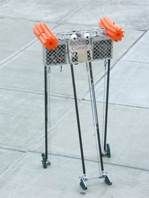
Cornell Rangerv1: 2001-6, v2.1: 2006-2008, v3: 2009-2012Powered, 4-leg "biped," no knees. Walks on level ground. Radio-control steering by twisting inner legs. Records: 9 km on April 3, 2009; 23 km (=14.3 mi) on July 5-6, 2010; 65 km (40.5 miles) on May 1-2, 2011. All without recharge or any human touch. |
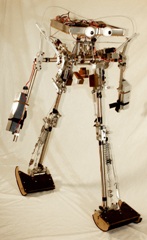
Powered Biped with Knees2003-2005Ankle powered, minimally controlled. Walks on level ground. Most energy-effective robot: 11 watts total, 0.2 J/N m. Science Magazine, 2005 |
|
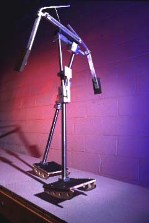
Passive Biped with Kneesv1 armless, v2 with arms (shown): 1999-2001Passive-dynamic, two legs and knees. The most advanced passive-dynamic robot to date. Walks downhill. J. Robotics Res., 2001 |
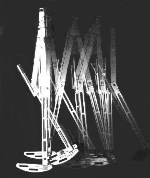
McGeer Copiesv1 & v2 (shown): 1996-20004 legged passive "biped" with knees. Walks downhill. Dynamics and Stability of Systems, 2000 |
|
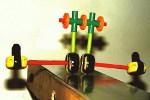
Tinker Toy Walkersv1 (shown) and v2: 1996-2001Passive biped. Can't stand stably in any configuration (even with splayed legs). Walks downhill. Phys. Rev. Letters 1998, PRL-E 2001 |

Cornell Tik-TokIn Progress Video overview of Tik-Tok (2 min) Funded by NSF Proposal (NRI program) Goal: Efficient, robust, and nimble legged robot. |